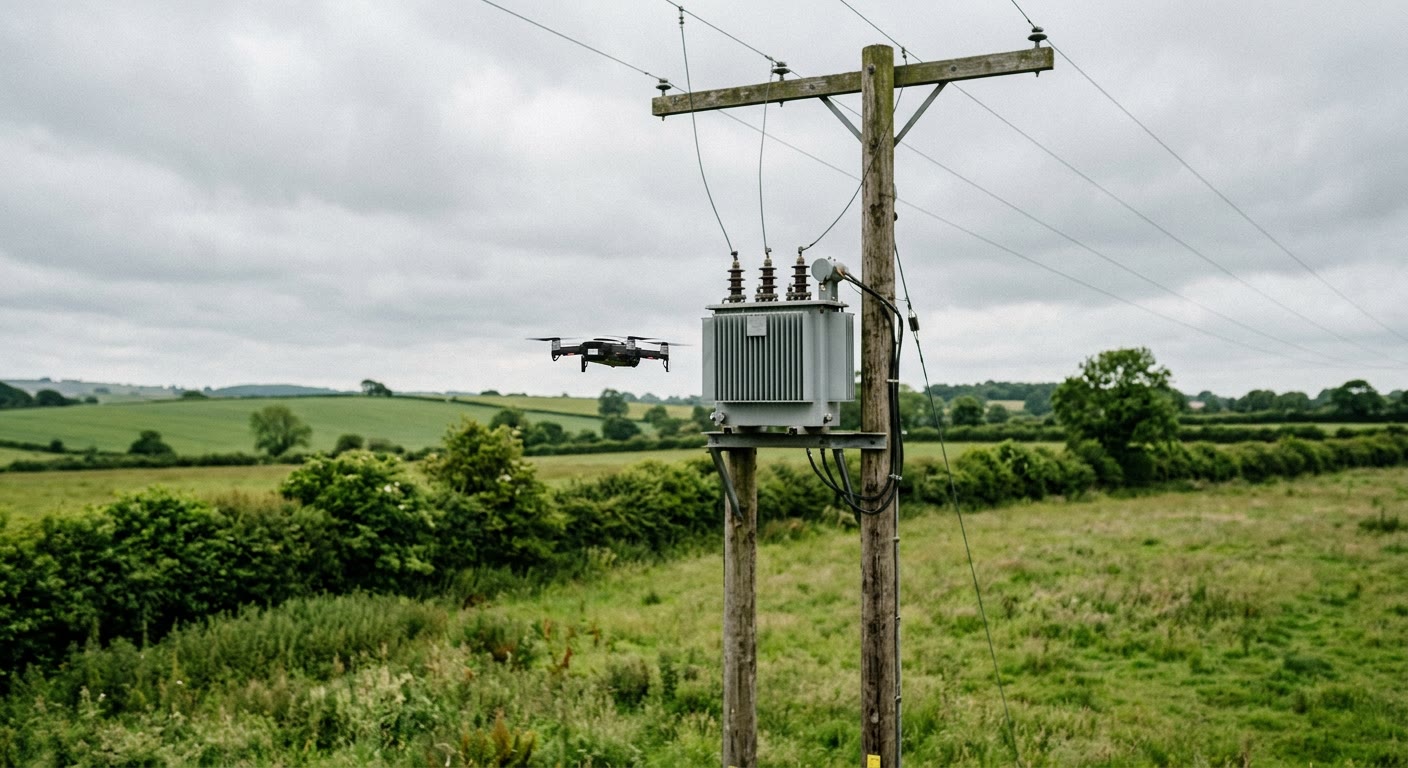
Team UAV says it has completed transformer inspections for an NGED AI project
Team UAV said on 21 October that it "has completed a drone inspection programme for National Grid Electricity Distribution (NGED), capturing high-resolution imagery of 500 pole-mounted transformers across its network to support an innovation project exploring how artificial intelligence (AI) could improve the way electrical infrastructure is inspected and maintained."
According to the release, the project is "Funded through the Network Innovation Allowance (NIA)" and "aims to investigate how drone imagery and computer vision can be used to identify visible signs of deterioration, including corrosion." It says "Team UAV was responsible for developing and delivering the drone inspection programme, while fellow NGED supplier Softwire is developing the computer vision models and prototype web application that will use the imagery to assess transformer condition."
The release says Team UAV "planned and delivered inspections across Cornwall, Wales, and the Midlands" and "built a custom GIS database and delivery process, allowing imagery to be uploaded from the field, linked to individual transformer locations and stored alongside relevant survey information and metadata."
Mark DeGiovanni, Technical Lead at Team UAV, is quoted: "For this project, our focus was on developing a consistent and repeatable approach to drone inspections, ensuring the imagery we collected was suitable for the next stage of AI analysis."
Favour Eboh, Innovation Engineer at National Grid Electricity Distribution, is quoted: "Working with Softwire and Team UAV, we will test the technology on an initial set of transformers and assess its potential to support future network asset management."
The release says: "The initial phase of the wider innovation project is expected to be completed by the end of 2026."
Unmanned Airspace reports a shared-airspace drone evaluation at Chorley
Unmanned Airspace reports that drone operators, regulators and UTM service providers "met in Chorley, in the northwest of the UK, on October 21 to witness the first operational evaluation of multiple drone operators flying beyond visual line of sight (BVLOS) missions sharing the same airspace, managed by a federated UAS traffic management (UTM) system."
According to the report, "In Chorley, Wing – with its vertically integrated UTM and operator services – and Manna and the Lancashire Fire and Rescue Service – using ANRA’s UTM system – shared strategic deconfliction and operational data via the ASTM F3548-21 Standard for USS interoperability under CAA supervision."
The report describes the event as "the first iteration of the “UK UTM Implementation” programme – part of the Civil Aviation Authority’s (CAA) Airspace Modernisation Strategy". It says that, according to Stuart Lindsey, Head of Airspace Modernisation with the CAA, this is the "first step in a three-step process to introduce scalable BVLOS commercial operations in the UK", and that "the next step, following a close evaluation of the performance of the system, will be to implement new prioritisation arrangements for safety-of-life drone operators."
On the airspace itself, the report says the system "is operating within a temporary danger area (TDA) for the early phases of development", and that "The TDA above Chorley is a 4km by 4km defined environment, with an altitude ceiling of 800ft above mean sea level (AMSL) – extended areas of operation can be expected from subsequent trial areas."
Amit Ganjoo, founder and CEO of ANRA Technologies, is quoted in the report: "These are operational flights, just as when we started in Texas, but with three operators sharing the same airspace. And we have the governance framework in place."
We have not found a CAA statement on the 21 October evaluation; this section relies on the Unmanned Airspace report.