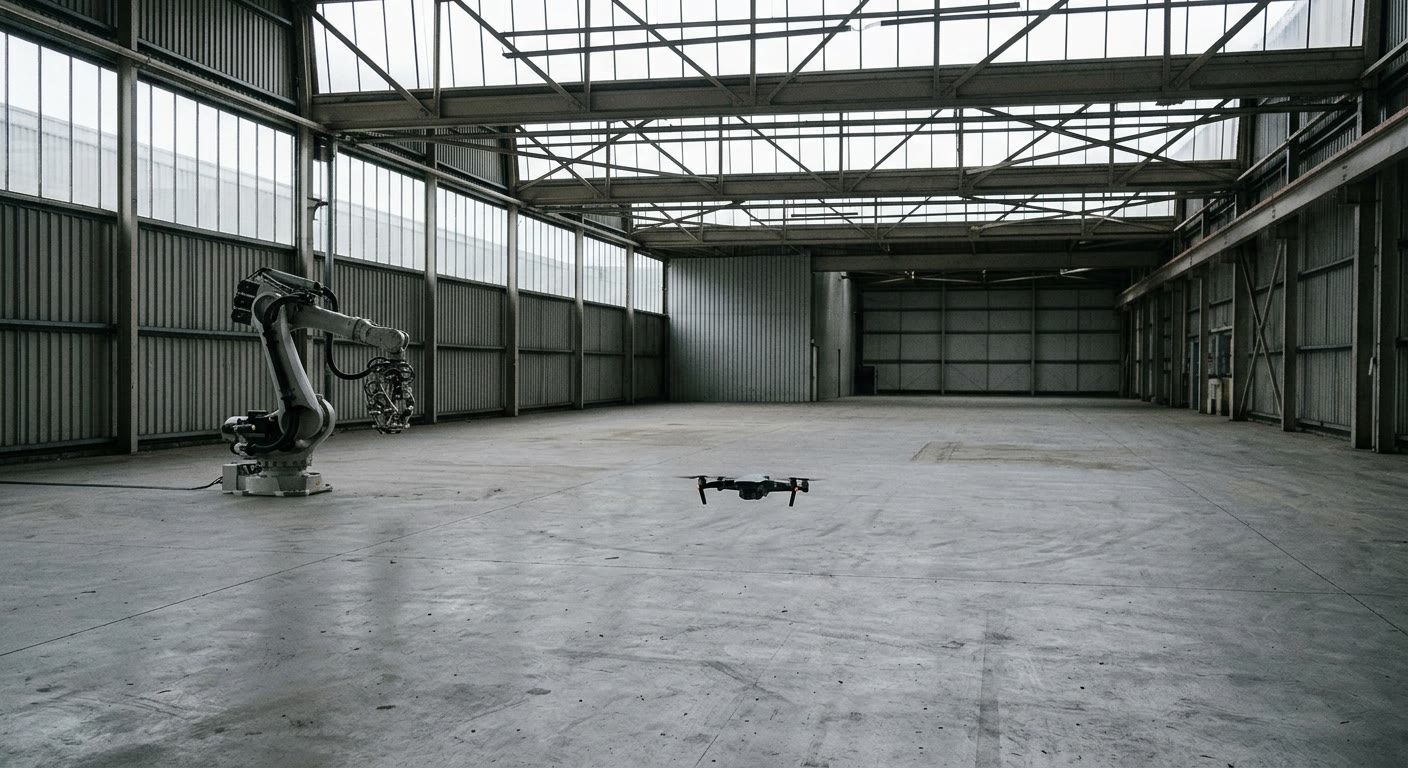
A national drone testing centre at Westcott
The Satellite Applications Catapult announced on 29 September 2026 that it is investing in a national drone testing facility at Westcott Venture Park in Buckinghamshire, backed by £2.25 million from Buckinghamshire Council. The National Autonomy and Drone Innovation Centre, or NADIC, was announced at the DroneX trade show in London and will expand the Catapult's existing Drone Test and Development Centre at Westcott. The Catapult says: "The facility will help solve one of the biggest practical barriers facing the UK drone industry: the shortage of accessible places for companies to prove their technology is safe."
The planned capabilities are a position, navigation and timing test facility for assessing how systems behave when satellite navigation is unavailable or disrupted, a satellite communications integration and test lab, a remote operations control centre, an indoor wind-generation system, a robotic arm for repeatable automated testing, and a motion platform that can recreate operations from moving vessels and vehicles. On timing, the release says: "The robotic arm, motion platform, and control room are expected to be operational from this autumn, with the full facility anticipated in the second half of 2027."
The release says "NADIC is designed primarily for small and medium-sized companies and component builders", which it describes as "the firms developing the navigation, sensing, communications and autonomy systems the wider sector depends on". The remote operations control centre is described as a place "where operators can train, simulate missions and validate remote command-and-control procedures under realistic operating conditions". The Catapult frames the need in regulatory terms: "The Government has set a target of routine drone flight beyond the pilot’s line of sight by 2027, and forecasts value the UK drone economy at up to £45 billion by 2030." It adds that "almost every commercial drone flight in the UK remains an exception rather than the rule, with individually authorised and time-limited trials".
John Abbott, chief executive of the Satellite Applications Catapult, said: "A company should be able to arrive with a system, establish its operational limits under controlled conditions, and leave with data that goes straight into a regulatory application. This facility offers a serious step forward for the sector." Steven Broadbent, leader of Buckinghamshire Council, said the Buckinghamshire Growth Fund "was created for exactly this purpose", called this "this first major funding decision", and added: "It’s important to note that this funding is dedicated to economic growth and investment activity and is not money diverted from day-to-day council services."
CAP 3040: a fourth edition, with a route to multi-site operations
The Civil Aviation Authority has published a fourth edition of CAP 3040, its policy concept for flying drones beyond visual line of sight in an Atypical Air Environment, or AAE. The CAA's publication page gives a version date of 29 September 2026; the document's own revision history dates the fourth edition 28 September 2026 and describes the change as "Minor corrections to main policy text and addition of Annex G." The policy concept was first published in October 2024.
The idea behind an AAE is set out in the document: "Operating an Unmanned Aircraft (UA) within an AAE reduces the likelihood of a mid-air collision (MAC) between an UA and other conventionally piloted aircraft." In practice that means airspace close to permanent infrastructure such as railways and wind farms, which the existing annexes cover. The contents page also lists annexes on power transmission and distribution networks and on agriculture, both marked as work in progress.
Annex G is the addition. It says: "This concept is intended to enable an organisation holding an AAE-based OA to conduct equivalent operations at additional sites without requiring a full reassessment of each location, provided that the operation remains within defined parameters and does not alter the safety case upon which the existing authorisation is based." The eligibility criteria require an established operator holding a valid AAE Operational Authorisation, named safety-critical roles within the organisation, a risk assessment for each additional location, and sites of the same kind: "all equivalent sites must be railway infrastructure, or all must be powerline infrastructure or similar asset types".
The document says: "An OA may be amended to allow an operator to conduct similar operations across multiple locations." It then sets out the step before flying at each new site: "Once an organisation has met all the requisite criteria detailed above for an equivalent operations OA condition, they will then be required to provide adequate notification to the CAA in advance of commencing operations." That notification is the operator's risk assessment and a completed airspace assessment checklist, submitted through ACOMS with the NOTAM request: "Unless otherwise agreed by the CAA, the notification should be submitted no less than five (5) working days prior to the required publication of the NOTAM." The document is clear about what that notification is not: "The CAA will not approve the airspace assessment checklist but will periodically assess the submitted documentation and may use it to inform oversight activity." It also says: "Any applicant for an AAE based OA is advised to engage early with the CAA via innovation@caa.co.uk prior to submitting their application."
Cyberhawk keeps SSE's networks for three more years
Ondas Inc., the Nasdaq-listed parent of the drone inspection company Cyberhawk, announced on 28 September 2026 that Cyberhawk has secured "a new three-year agreement, with an option to extend for a further two years, with SSE plc's economically-regulated networks businesses, SSEN Transmission and SSEN Distribution for the provision of specialist drone inspection and surveying services across its British electricity networks". The release says the scope has grown: "Cyberhawk has also been awarded Lot 2 for offshore wind turbine inspection, extending the scope of the partnership into SSE's offshore renewable energy assets."
Chris Fleming, chief executive of Cyberhawk, said: "The fact that SSE has awarded Cyberhawk a third major long-term agreement, following two previous five-year agreements, is a strong testament to the value and trust we have built together." Ondas says the relationship with SSE has run for more than ten years and that Cyberhawk has also renewed a multi-year agreement with SSE for its iHawk inspection data platform. It adds that "SSE plans to invest £33bn in energy infrastructure by 2030". Unmanned Airspace, reporting the agreement on 29 September, notes that "Cyberhawk holds active beyond visual line of sight permissions in both the UK and US."
Why it matters to UK operators
The CAP 3040 change is the one to read if you hold, or are applying for, an AAE-based Operational Authorisation for rail, powerline or similar infrastructure work. Annex G describes a route to conducting equivalent operations at additional sites under an existing authorisation without a full reassessment of each location, on the operator's own risk assessment and an airspace checklist, with the notification due at least five working days before the NOTAM is published unless the CAA agrees otherwise. The document itself advises early engagement with the CAA before applying. The Westcott centre is aimed at the small and medium-sized companies and component builders developing the systems "the wider sector depends on", and the Catapult's stated goal is test data that goes straight into a regulatory application; the first equipment is due this autumn. The Cyberhawk agreement is a three-year award, with an option for a further two years, across SSE's transmission and distribution networks, now extended to offshore wind turbine inspection.