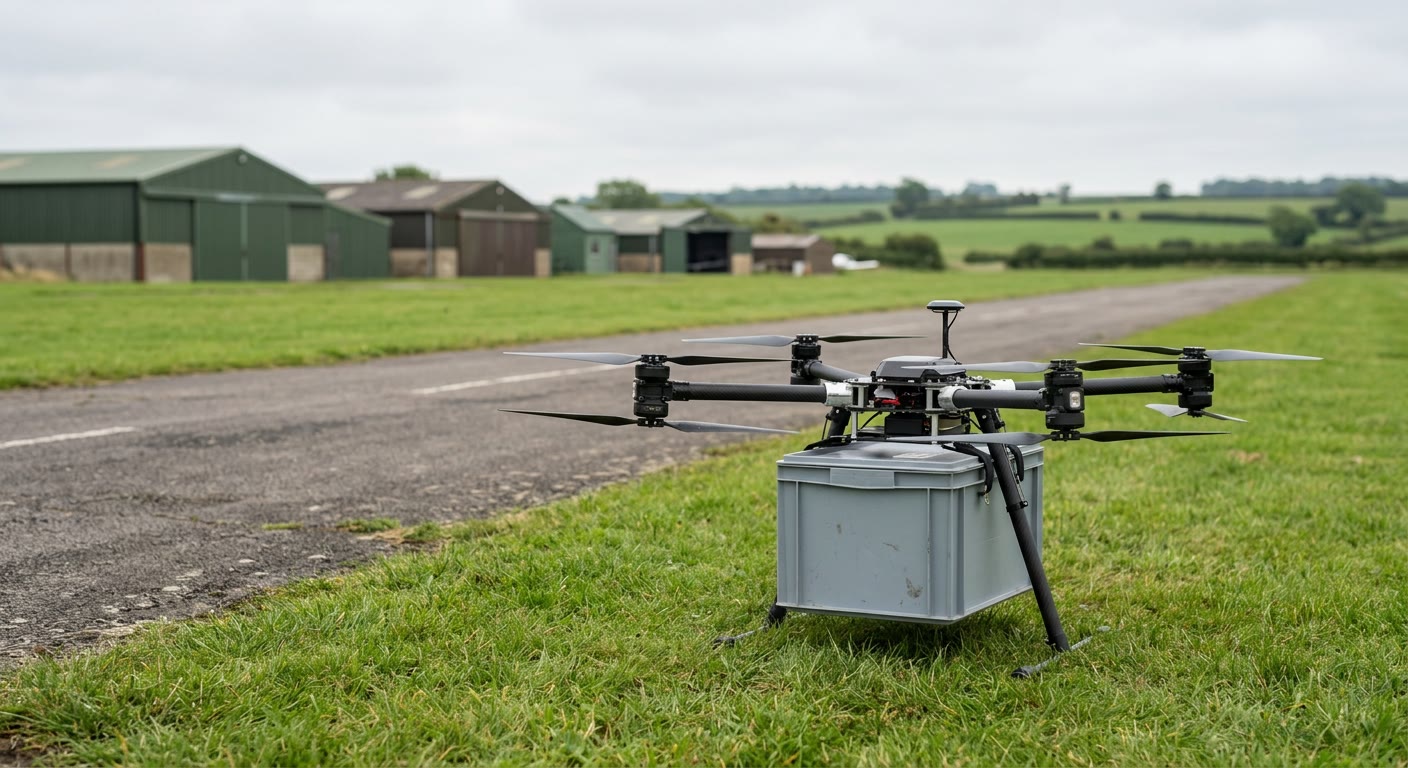
Viking Drone Packaging, a West Sussex company based at Goodwood Aerodrome near Chichester, says it "has achieved a world first after receiving a Letter of Recommendation from the UK Government's Vehicle Certification Agency (VCA) for a crash protected container designed specifically for the transport of radiopharmaceuticals by drone". The company announced the recommendation on 24 September 2026.
What the recommendation says
According to the company, the recommendation confirms that its packaging "meets the VCA's performance requirements for RPAS (Remotely Piloted Aircraft System) crash protected containers". The VCA's Dangerous Goods Office is the UK body that certifies packaging for the transport of dangerous goods.
The container was "Developed in collaboration with regulators, NHS stakeholders and drone operators over more than two years" and is built to carry time-critical radiopharmaceuticals "such as Gallium-68, used in diagnostic imaging". The company explains the urgency in one line: "Because these medical isotopes have extremely short half-lives, rapid and reliable delivery is essential to maximise their clinical value."
How it was tested
Viking says the container went through "multiple helicopter drop tests from 400 feet onto an unyielding surface", and that the testing showed "the dangerous contents remained safely contained even under severe impact conditions".
The company also says the work changed the assessment itself: "Existing crash protected container criteria did not adequately address the transport of radioactive materials by drone, resulting in the VCA expanding its assessment criteria to accommodate this new class of packaging". On that basis it describes the recommendation as the first of its kind.
What it does not do
Viking is careful about the limit of the letter: "While the recommendation does not itself authorise commercial drone operations, it provides a critical component of the wider Civil Aviation Authority approval process required before operators can transport dangerous goods by drone."
That matches the CAA's own guidance. The regulator's page on carrying goods states: "You must get an additional approval from us before using your drone or unmanned aircraft to carry dangerous goods." It adds: "This approval is in addition to the requirement to have an Operational Authorisation." The detailed guidance is CAP 2555.
Who is behind it
Geoff Leach, Co-founder of Viking Drone Packaging, said: "This has been one of the most rewarding projects of my career." He said he had worked in the safe transport of dangerous goods for more than thirty five years and that it was exciting to see that expertise opening up healthcare logistics. He added: "If we can contribute to getting time-critical medicines to patients more quickly and reliably through safe drone operations, then that will be a tremendous achievement."
The company describes Leach as the "former Head of the UK Civil Aviation Authority's Dangerous Goods Office, former Chair of the ICAO Dangerous Goods Panel". It describes itself as "the world's first packaging provider dedicated exclusively to drone packaging solutions".
The background
This is not the company's first container to pass a UK test regime. DroneLife reported on 18 September 2023 that Viking had received a crash protected container certification from the UK, and that "The UK Civil Aviation Authority led a project involving the Vehicle Certification Agency (VCA) and key industry stakeholders to develop this test procedure. This procedure includes dropping a package from a helicopter 400ft in the air, which was determined to be the typical drone operating altitude."
At the time, co-founder David Weilert was quoted by DroneLife saying "Our next focus is on providing a solution for transporting radiopharmaceutical therapies for use in cancer treatment". The 2026 recommendation covers radioactive material, although the example the company gives is a diagnostic imaging isotope rather than a cancer therapy.
Viking says the same approach can go further: "Future applications include other dangerous goods as well as specialist healthcare, industrial and offshore logistics".
Why it matters to UK operators
Carrying dangerous goods by drone in the UK needs two things from the CAA: an Operational Authorisation and a separate approval to carry dangerous goods. Viking describes its container as a component of that wider approval process, not a substitute for it. On the company's account, the existing container criteria did not cover radioactive material until the VCA widened them for this packaging. This letter is one supplier's answer to that gap, for one class of goods. It is not a permission to fly, and any operator planning NHS isotope work will still be applying to the CAA in the usual way.