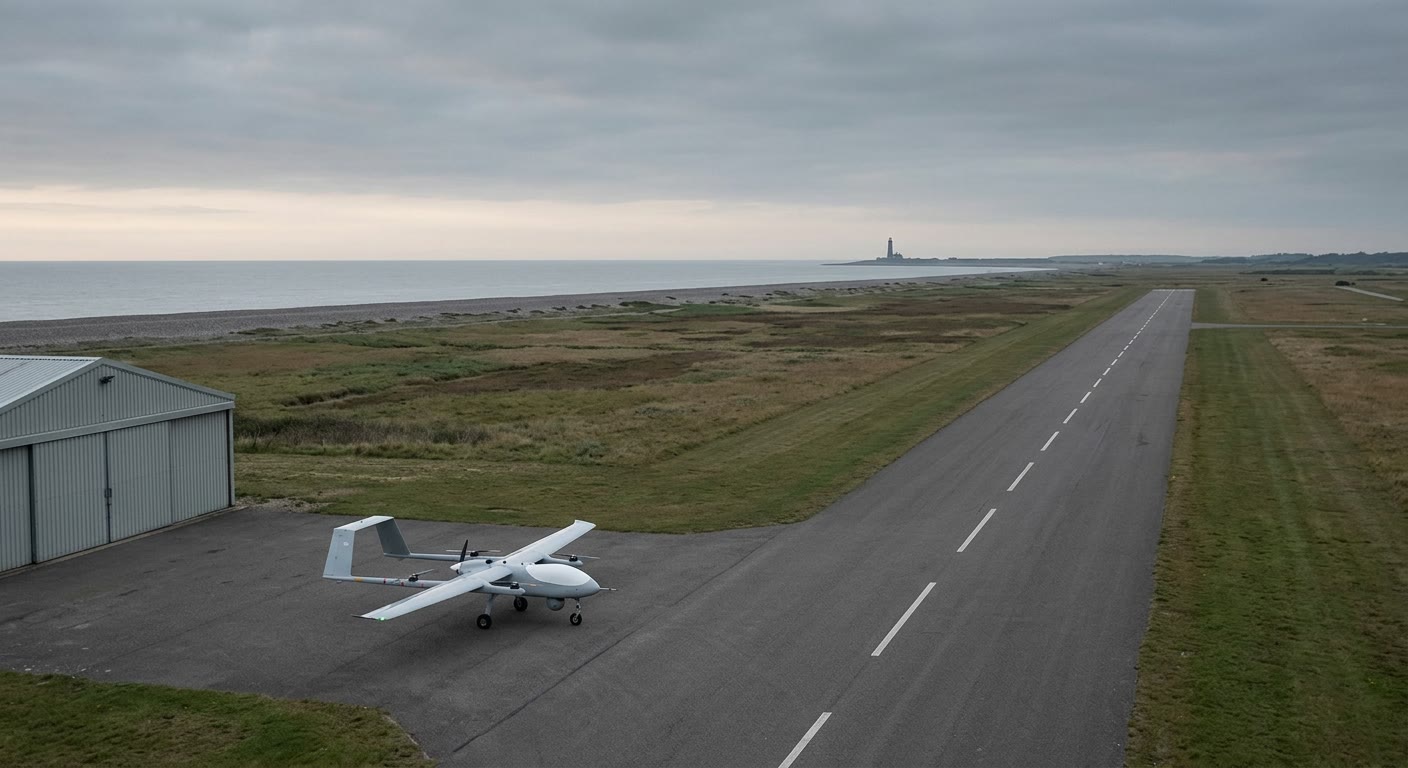
A think tank has asked the government to fast-track airspace changes at Lydd Airport on Romney Marsh so that it can become a national test site for drones and autonomous aircraft, and it names two more regional airports it wants to follow.
The Good Growth Foundation's report, which Kent Online says is called "A Golden Ticket for Government", was reported on 8 September by three regional outlets in the same morning. Kent Online reports that the foundation "is calling on the government to fast-track airspace changes at Lydd Airport, on Romney Marsh, which would allow it to become a flight tech centre", and that "GGF has identified Lydd Airport as the most prepared site in the country to prove the model if it can be granted Special Use Airspace (SUA) designation".
What the report is asking for
The proposal is at the advocacy stage. There is no planning application, no funding decision and, in the reports we have read, no response yet from the Department for Transport or the Civil Aviation Authority.
The argument is about time. The Doncaster Free Press reports that "current rules around airspace change proposals for airports, a process the Civil Aviation Authority (CAA) does not expect to complete until May 2027 at DSA, can 'take years to complete', the GGF said". It adds that the think tank is "urging the Government to use existing powers to speed-up airspace change proposals like Doncaster's". Business Live reports that the foundation "is urging transport secretary Heidi Alexander to accelerate changes that would allow for more flight testing of drones and other emerging technologies".
The mechanism the report proposes is a managed block of airspace. Business Live says the report argues that "by having a specific managed airspace area, drones, autonomous aircraft and conventional aviation would be able to operate 'safely together, helping to attract investment in the third generation of flight'". The CAA's own process for changing how a piece of UK airspace is used or classified is set out in its guidance CAP1616.
Why Lydd
Kent Online says the airport "is the only licensed UK airport already integrating drones with traditional flight, sits on the English Channel - one of the world's six critical maritime chokepoints - and already hosts Home Office, Small Boats Operational Command, search and rescue and Maritime and Coastguard Agency operations." The airport's own uncrewed aviation page describes Lydd as "a first mover in the creation of Fixed wing and UAS integration practices". Today, operators wanting to fly inside its flight restriction zone submit a drone request form "at least 5 working days in advance of the proposed flight", and approved flights are capped at "400 feet AGL unless otherwise approved".
The airport's commercial position is weak. Kent Online reports that "Civil Aviation Authority (CAA) figures show just five commercial passengers were recorded in 2024, followed by 18 in 2025", and describes the airport as "surviving only due to cash pumped in by its owner - the Saudi Arabian billionaire Al Athel family." It opened in 1954 and, according to the same report, was handling more than 250,000 passengers a year by 1959 before the air ferry trade collapsed.
Samantha O'Dwyer, the airport's chief executive, is quoted as saying: "We are excited to see our strategy for Lydd beginning to take shape. Our Centre for Future Flight Innovation presents a significant opportunity to create employment and drive economic growth, both in Kent and potentially across the country, while providing a blueprint for the future of the UK's regional aviation."
The numbers, and where they come from
All of the jobs and value figures are the foundation's own estimates, as reported by the three outlets. We have not been able to read the report itself: the foundation's website did not return any content when we tried on the morning of publication.
- Lydd: Kent Online reports that "GGF states the proposal could support 535 direct jobs at the airport, with more than 1,000 jobs supported in the wider economy through supply-chain and local-spending effects", and "an estimated annual gross value added of £75.5 million to the local economy, GGF suggests".
- Doncaster Sheffield Airport: the Doncaster Free Press reports that, if the Lydd model works, "the ideas being trialled in Kent could be transferred to DSA, potentially bringing up to 800 direct jobs and £110million for the local economy".
- Cotswold Airport: Business Live reports that the report "argues Cotswold Airport could become a centre for drones, aerospace engineering, testing, advanced logistics and autonomous aviation, creating up to 450 skilled jobs", and identifies it as a "strong potential candidate" for airspace reforms because of its aircraft storage and maintenance activity, available operational space and relatively low-congestion airspace.
Praful Nargund, the foundation's director, is quoted by Kent Online as saying: "Developing Lydd Airport is exactly the sort of opportunity the government should be backing. It would boost the local economy and establish a model that can be replicated across the country to fulfil their promise of good growth in every postcode."
Tony Vaughan, the Labour MP for Folkestone and Hythe, is quoted in support: "With the right backing from government, Lydd can be a powerful example of what that looks like in practice."
What it means for operators
Nothing changes today. Lydd's flight restriction zone, its request form and its 400 ft cap all stand until the CAA approves an airspace change, and the report itself acknowledges that the existing process runs for years. What the report does signal is a policy push for dedicated drone test airspace at regional airports, framed around jobs, and aimed at the Transport Secretary. The Doncaster Free Press notes that the foundation sees the commercial roles for such sites as including "drone inspection and software and airspace-management systems", which is the part of the market most UK operators actually work in.
If the government responds, the first visible step would be a CAA airspace change proposal for Lydd. We will report it when one appears.